


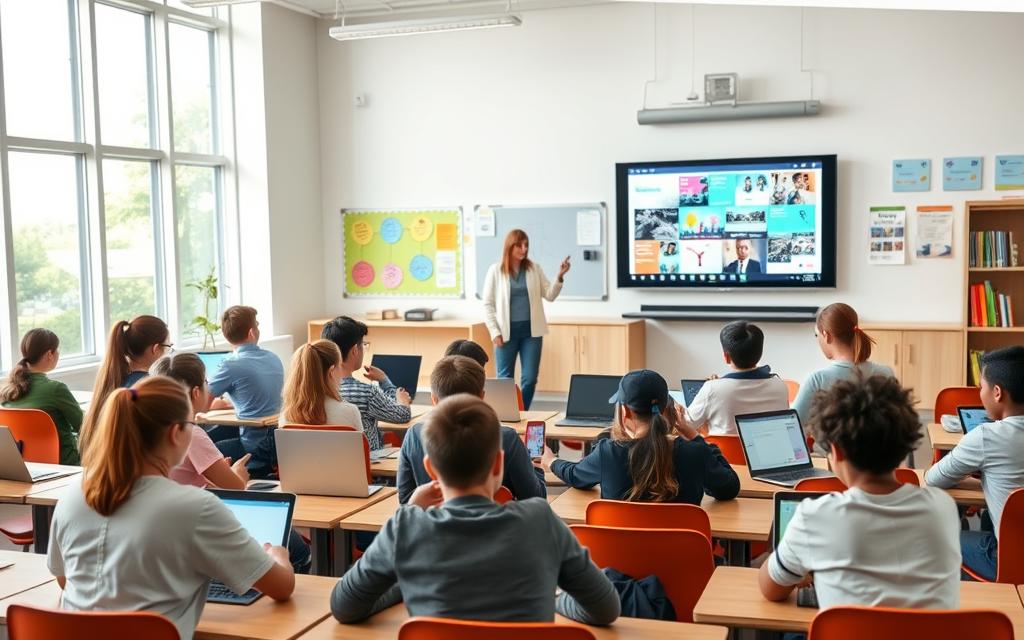
Modern classrooms have changed a lot thanks to new technology. Laptops and tablets, along with special apps, are now key parts of learning.
The use of digital learning tools brings both good and bad sides. They make learning more fun and tailored to each student. But, there’s worry about too much screen time and getting distracted.
The argument about technology in education needs careful thought. We’ll look at both sides to understand its effect on students’ success.
It’s important to use these tools right. This way, we can enjoy their benefits without the downsides in our digital learning journey.
The Digital Transformation of Modern Education
Educational technology has changed learning in American schools. Now, classrooms are dynamic, blending old teaching methods with new tech. This shift moves learning from chalkboards and books to digital platforms.
Historical Context of Educational Technology
The story of educational technology started long ago. In the 1920s, teaching machines introduced programmed learning. The 1950s saw language labs using audio to improve learning.
The 1960s marked the beginning of computer-assisted learning, but it was pricey and rare. The 1980s brought personal computers to some classrooms. The 1990s added the internet, opening new doors. Interactive whiteboards arrived in the 2000s, and now we have cloud-based platforms, AI, and VR changing education.
Current Technology Adoption Rates in US Classrooms
Today, American classrooms are full of technology. The HMH 2024 Educator Confidence Report shows 81% of teachers see tech as a plus. This shows teachers value both old and new teaching methods.
Related Posts:
- Does Georgia Institute of Technology Require the SAT…

- How Many Technology Companies Are in the World A…

- What Is Machining Technology The Process of Shaping…

- What Is Biorock Technology Mineral Accretion for…

- How Does Cloud Technology Work Storing and Accessing…

- What Is the Forbes Technology Council An Elite…

Despite big investments in tech, many schools face challenges. Education systems worldwide focus on ICT, but just having tech doesn’t mean better results. It’s about how well it’s used.
There’s a big difference in tech use across districts and states. Some schools have lots of devices and systems, while others have less. This creates gaps in access and quality.
Knowing the edtech benefits and the classroom technology pros and cons helps teachers choose wisely. The digital shift keeps evolving, needing constant review to make sure tech really helps learning.
Enhanced Learning Opportunities Through Technology
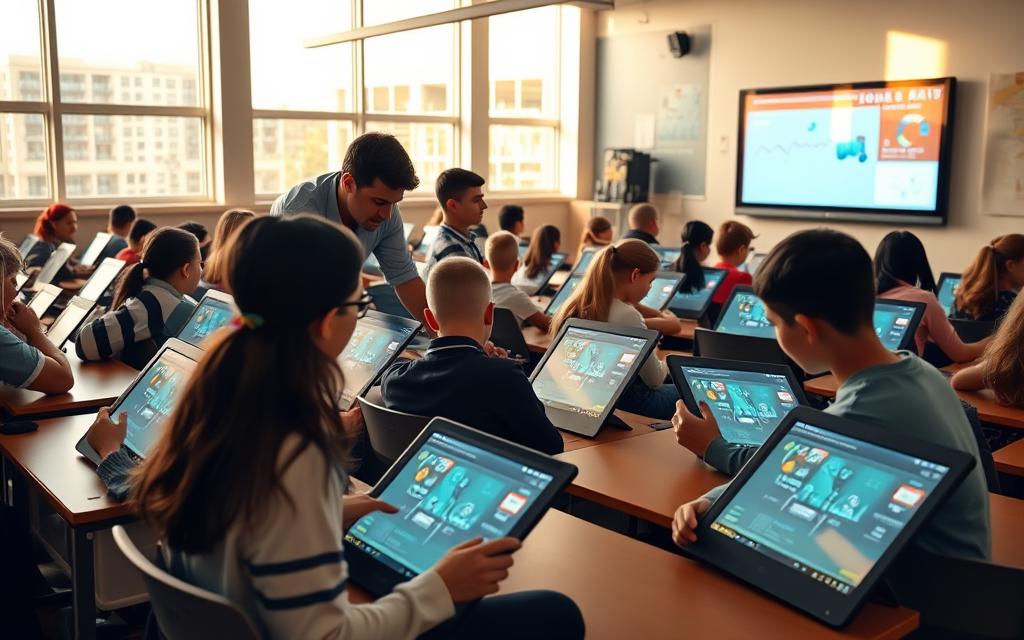
Educational technology has changed how students learn, opening new doors for growth. Digital tools turn classrooms into lively places where everyone can learn at their own speed.
Personalised Learning Experiences
Technology lets students follow paths that fit their needs and pace. Programs like HMH Personalised Path adjust to how well students do, making learning just right.
This way, students face challenges that are just right, not too hard or too easy. Teachers get to see how students learn, helping them focus on what’s needed most.
The system spots where students need help and gives them exercises to practice. This personalised learning helps students grow and feel more confident.
Access to Global Educational Resources
Technology lets students reach out to top educational materials worldwide. Online libraries and databases offer info that many schools can’t provide.
Students can explore museums and historical sites online, or work with others from different places. This global connection brings new views and research to their studies.
There are thousands of e-books, papers, and multimedia resources available. Teachers can use current events and real-life examples to make learning more interesting.
Interactive and Multimedia Content
Digital tools make learning fun by bringing subjects to life. Interactive simulations let students try out scientific or historical ideas safely.
Video and animations help explain tough topics in a way that’s easy to understand. These tools help all kinds of learners stay engaged.
Many platforms use gamification in education, making learning fun with rewards. This method keeps students motivated and helps them learn through fun activities.
When students are active in learning, they remember more. Multimedia tools help create lasting memories that support long-term learning.
Improved Student Engagement and Motivation
Modern educational technology offers powerful tools to capture student interest and maintain motivation. These digital solutions transform traditional classrooms into dynamic environments. Students actively participate in their education.
Gamification and Learning Applications
Educational games are a key way to boost student engagement. Programmes like Waggle show how game-based learning makes skills practice enjoyable and effective.
These applications challenge students to think critically and solve problems in interactive environments. The gamified approach turns learning into an adventure, not a chore.
When used wisely, these tools make productive use of screen time in schools. They turn distractions into valuable learning opportunities.
Collaborative Learning Platforms
Digital platforms enable real-time teamwork and communication between students. These tools foster social learning experiences that mirror modern workplace collaboration.
Students develop essential teamwork skills while engaging with course material. The technology facilitates peer-to-peer learning and collective problem-solving.
These platforms create inclusive environments where every student can contribute. They break down traditional classroom barriers to participation.
Real-time Feedback Mechanisms
Immediate feedback is a big advantage of student engagement technology. Systems like the HMH Performance Suite provide teachers with real-time performance data.
This instant insight allows for timely interventions when students struggle. Educators can adjust instruction based on current classroom needs.
The technology also offers customisable lessons that maintain student interest. Ready-to-teach materials save preparation time while keeping content fresh and engaging.
These feedback systems help create responsive learning environments. They ensure that instruction remains aligned with student progress and comprehension.
Developing Essential Digital Literacy Skills
In today’s digital world, schools are key places for learning important skills. They use technology to teach students how to use digital tools. This helps students learn skills they can use in real life.
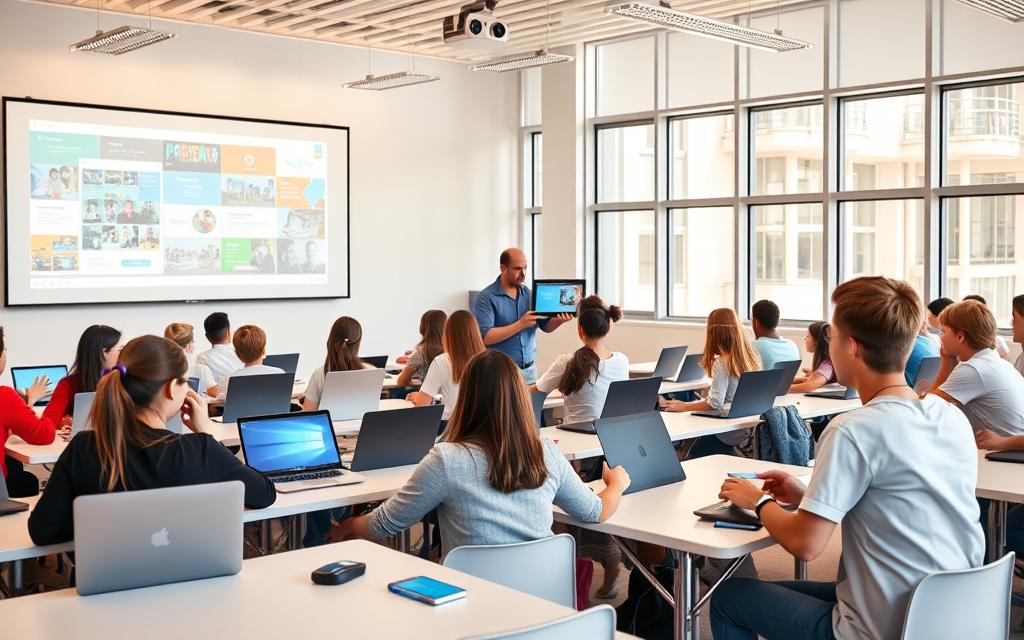
These skills are the base for future skills education. They help students not just pass exams but also succeed in life after school. Students learn soft skills like communication and problem-solving through technology.
Preparing Students for the Digital Workforce
Using technology in class helps students get ready for work. As jobs become more digital, employers want people who know how to use technology. Schools teach these skills by using technology in class.
Students learn to use software and work online together. They practice using tools and systems that are like what they’ll find in the workplace. This makes them confident and ready to learn new things.
The British Columbia government’s AI in education initiative shows how schools can prepare students for new technologies. It helps students learn skills that are useful in the workplace.
| Digital Skill | Classroom Application | Workplace Relevance |
|---|---|---|
| Online Collaboration | Group projects using shared documents | Teamwork in distributed work environments |
| Information Management | Organising research using digital tools | Data organisation and retrieval systems |
| Technical Troubleshooting | Solving device and software issues | Workplace technology problem-solving |
| Digital Communication | Email etiquette and video conferencing | Professional digital correspondence |
Critical Thinking and Information Evaluation
The internet makes it hard to know what’s true. Students need to learn how to tell real information from fake.
Classrooms teach students to question sources and check facts. They learn to spot bias and be careful with online information. This helps them in school and in life.
Being able to judge information is a key part of digital literacy. It’s important for students to learn this skill in school.
Teachers can help students learn to evaluate websites and spot fake news. These skills help students in school and in their future careers.
Addressing Diverse Learning Needs
Digital tools have changed how teachers help students in today’s classrooms. They offer flexible solutions for different learning styles and needs. This makes learning more fair for everyone.
Assistive Technologies for Special Education
Special digital tools help students with disabilities a lot. Text-to-speech software turns written text into sound, helping those who struggle with reading. Closed captioning helps students who have trouble hearing or processing sound.
Screen readers and voice recognition tools let students with physical disabilities use digital content. These tools make learning more accessible. The right assistive technology can really help students overcome learning barriers.
Many digital platforms now have adjustable font sizes and colour options. They also have keyboard navigation for students with visual or motor skill challenges. Educational technology keeps getting better to meet different needs.
Differentiated Instruction Tools
Adaptive learning software is a big step forward in personalised learning. It changes the difficulty of content based on how well students do. Students get learning paths that fit their level and pace.
Digital tools offer different ways to learn the same thing. Visual learners get infographics and videos, while auditory learners get podcasts. Kinesthetic learners use interactive simulations.
Teachers can use technology to make different kinds of tests. Quick polls and digital quizzes give feedback right away. This helps teachers adjust their teaching to meet students’ needs better.
| Technology Type | Primary Function | Student Benefits | Implementation Examples |
|---|---|---|---|
| Text-to-Speech Software | Converts text to audio output | Supports reading challenges, visual impairments | NaturalReader, Read&Write |
| Adaptive Learning Platforms | Adjusts content based on performance | Personalised pacing, targeted support | DreamBox, Smart Sparrow |
| Communication Tools | Facilitates alternative expression | Assists non-verbal students, language learners | Proloquo2Go, Boardmaker |
| Visual Organisers | Structures information visually | Enhances comprehension, memory retention | Inspiration, MindMeister |
These technologies help make education more inclusive. They let teachers set high standards while supporting students in different ways. Technology makes it possible to really tailor learning to each student’s needs.
Students who speak different languages also benefit a lot. Tools like translation software and visual dictionaries help them understand better. These tools make learning more accessible for them.
Using these tools well needs careful planning and training. When done right, technology helps create a fair learning environment for all. This is what universal design for learning is all about.
Is technology in the classroom good or bad: The Critical Analysis
To understand technology’s role in education, we need to look beyond what’s obvious. We must examine real evidence and long-term studies. This helps teachers see both the immediate and lasting effects of digital tools in the classroom.
Measuring Academic Outcomes and Performance
Studies show a complex link between technology and student success. A detailed study by Pan et al. (2022) found that games can boost students’ grades in many subjects. Digital games, in particular, are showing great promise in STEM fields, leading to better learning outcomes.
But, the success of technology depends on how it’s used. Talan et al. (2020) found that educational games have a moderate effect on grades. Yet, non-digital games seem to have a bigger impact. This highlights that technology itself isn’t automatically superior—it’s how teachers use these tools that matters.
Recent studies suggest that technology has a moderate positive effect on learning. But, the results vary based on:
- Specific technology applications used
- Subject matter and learning objectives
- Teacher training and implementation methods
- Student age and technological familiarity
Long-term Educational Benefits Assessment
Technology’s long-term effects on skills and readiness for the future need careful study. Digital tools can prepare students for modern workplaces. But, their lasting benefits depend on how they’re used in the classroom.
Technology’s greatest value lies in teaching adaptable learning and digital skills. Students who use technology well can solve problems better and feel more comfortable with digital changes. These skills help them be more ready for the future.
Yet, technology has its limits. Basic skills like reading and maths might be better learned through traditional methods. This shows that a mix of old and new teaching methods is often the best way to achieve educational outcomes.
The best use of technology is when it supports, not replaces, proven teaching methods. Teachers should always check if technology really helps meet learning goals or just adds novelty without real academic performance technology benefits.
Potential Negative Impacts on Student Development
Technology brings many educational benefits but also challenges. These include cognitive and social issues that affect students’ growth. Educators must think carefully about these concerns.
Digital Distraction and Attention Span Concerns
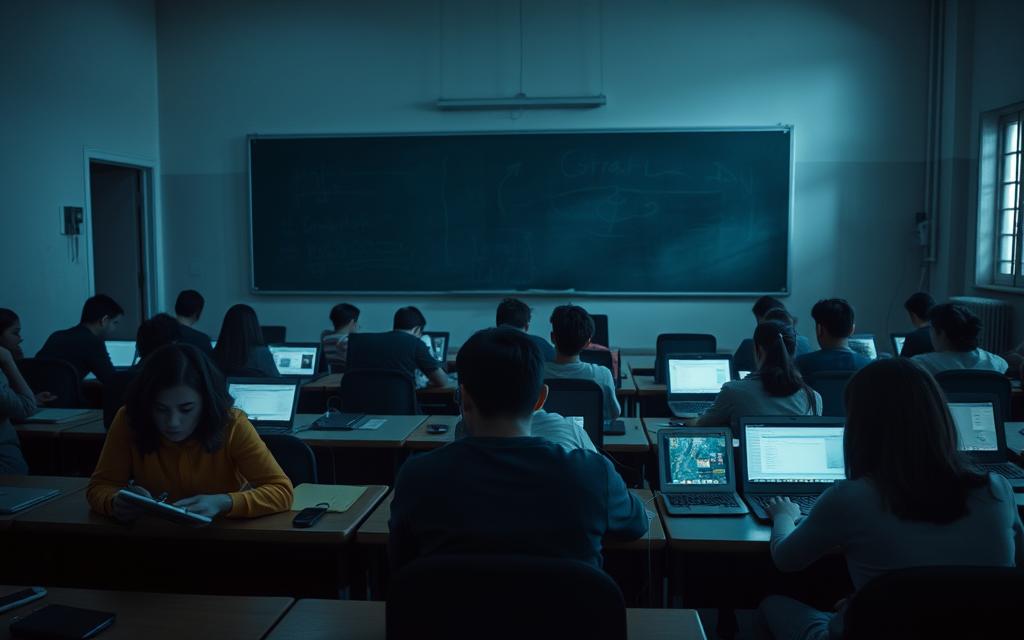
Classroom devices can distract students more than help them learn. They are tempted by ads, social media, and entertainment sites.
This constant distraction can shorten students’ attention spans. Studies show it’s hard for young minds to focus on complex tasks with so many interruptions.
Reduced Face-to-Face Social Interaction
More screen time means less talking to people. Many teachers fear that too much tech use harms social skills.
Skills like reading faces, understanding emotions, and taking turns in conversations come from talking to others. Too much tech use might limit these important skills.
Over-reliance on Technology for Basic Skills
Students might rely too much on tech for basic skills. This could mean using calculators instead of doing math in their heads, or relying on spell-check instead of learning to spell.
Skills like handwriting, memorising, and critical thinking without tech are vital. A good balance is needed so tech helps, not hinders, these skills.
Educators need to find ways to use technology wisely. They must ensure it helps students grow without causing harm.
Equity and Access Considerations
New technology in schools has brought a new kind of inequality. The promise of better learning through tech risks making gaps wider if not everyone has access.
The Digital Divide in American Education
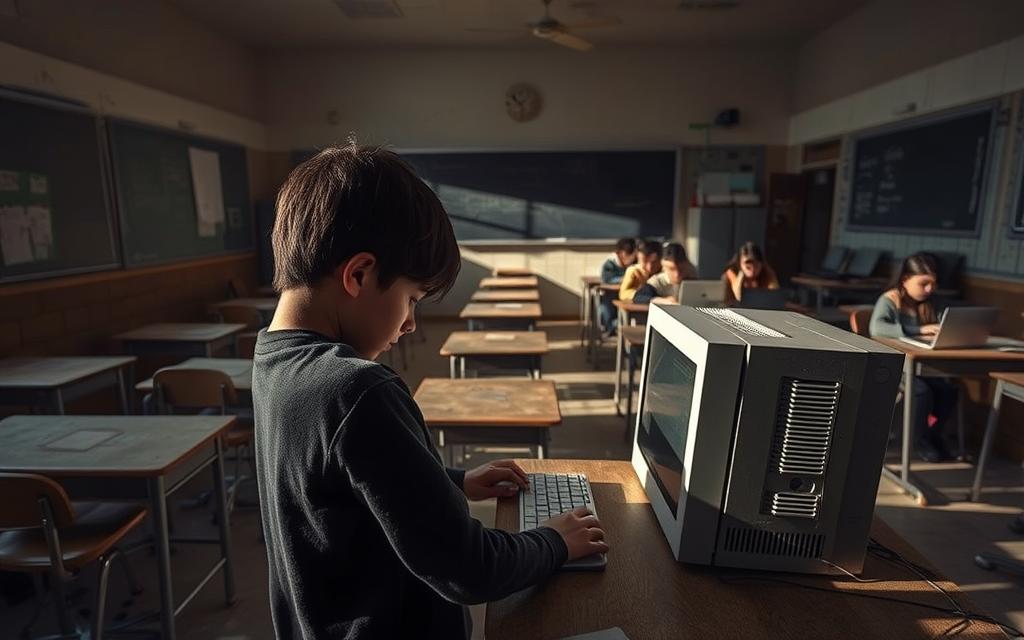
The digital divide shows the gap between students with and without tech. This gap is big in rural and urban areas where internet is scarce.
Students from poorer backgrounds face extra challenges. They might not have internet at home or use unstable mobile data. This makes it hard for them to do homework or use online resources.
Some schools are trying to fix this problem:
- Mobile Wi-Fi hotspot lending programmes
- Extended school library hours with technology access
- Community partnerships with local businesses for internet access
Socioeconomic Barriers to Technology Access
Money is a big problem for students. It’s not just about internet. Many families can’t afford computers or tablets for each child.
It’s not just the cost of devices. There are also costs for software, upkeep, and replacing broken items. These costs are hard for low-income families to handle. They often have to choose between school tools and basic needs.
Groups working in education know they must tackle these money issues. They are trying different ways to help:
- Schools giving out technology to students who need it
- Grants for tech in areas that need it most
- Companies helping schools with technology
Lawmakers have a big role in making sure all students get to use new tech. They can help by supporting internet in poor areas and funding for school tech.
Teacher Training and Professional Development
Without proper training, even the best classroom tech can go unused. Schools must boost their digital skills to use tech well. This means training both students and teachers to use technology effectively.
Studies show tech improves learning and helps teachers get better at their job. This is why teacher training technology needs a lot of focus and planning.
Effective Technology Integration Strategies
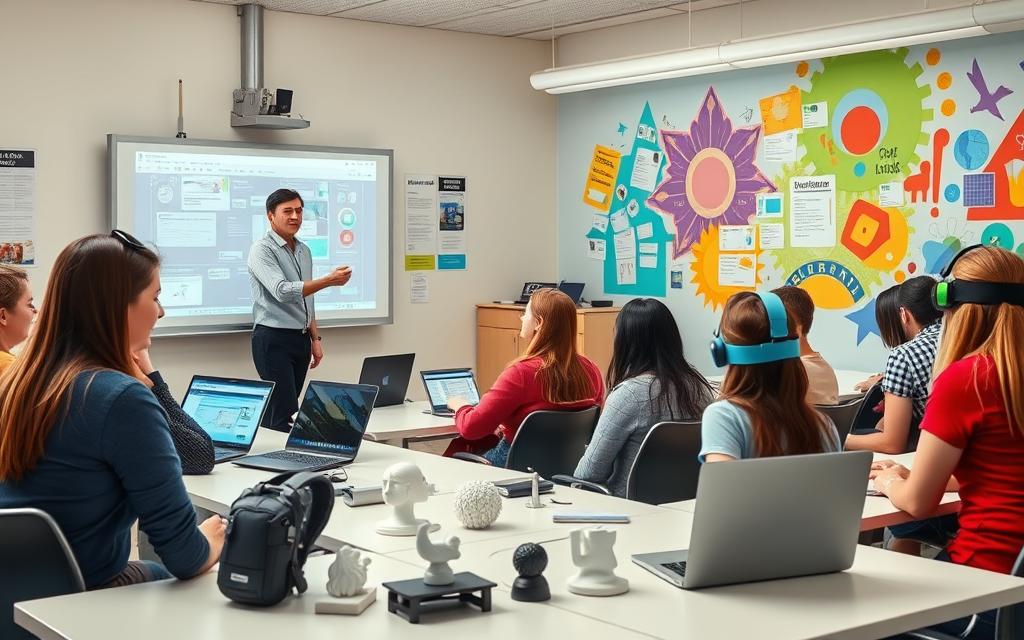
Good tech use starts with teaching methods, not just tech skills. Teachers should mix digital tools into lessons smoothly. This way, tech helps learning, not hinders it.
Using data to guide teaching is a key tech benefit. Tools like HMH Ed help teachers see how students are doing. This lets teachers give better support and help.
Good tech use includes:
- Starting small with clear goals
- Teachers and tech experts working together
- Checking how tech affects learning
- Sharing tips and ideas
Ongoing Support and Resource Allocation
Starting training is just the first step in professional development edtech. Teachers need ongoing help as tech changes. This could be through regular workshops or online groups.
It’s also key to have enough money for tech and time for teachers. Schools should plan for both. Having tech experts on hand helps a lot.
Seeing teacher training technology as an investment is important. When teachers are confident with tech, they can try new things. This leads to better learning for students.
The link between professional development edtech and student success is strong. Trained teachers use tech to boost skills like thinking and teamwork in students.
Balancing Traditional and Digital Pedagogies
Finding the right mix between old teaching methods and new digital tools is a big challenge. The best approach combines both to make a full learning space. This way, each method’s strengths are used to improve learning.
Blended Learning Approaches
Blended learning mixes online materials with classroom teaching. It lets students use digital tools and also have face-to-face time with teachers. This mix makes learning flexible and meets different student needs.
Many schools use a rotation model. Students switch between online learning and teacher-led lessons. This helps control screen time and improves both digital and social skills. HMH’s Learning Experience Design teams have created solutions that make it easy to adjust device use based on learning goals.
Good blended learning spaces have:
- Set times for digital and non-digital activities
- Online and offline content that connects well
- Regular checks on learning progress
- Training for teachers using new methods
Maintaining Fundamental Teaching Principles
Even with new tech, basic teaching ideas are key. Things like direct teaching, critical thinking, and personal guidance can’t be fully done online. Technology should help these ideas, not replace them.
The best classrooms use tech to help meet learning goals. Digital tools can offer extra practice or research, but teachers are always in charge. This way, tech helps learning, not leads it.
Teachers should use tech wisely. It should:
- Help meet learning goals, not decide the curriculum
- Enhance human interaction and guidance
- Grow with students’ digital skills
- Be mindful of screen time and digital balance
The debate on old vs new education is about making learning fit for the future without forgetting the past. When done right, tech can be a great help in education, not a problem.
Privacy and Data Security Concerns
Digital tools are now common in classrooms. Keeping student info safe is key. Schools must balance privacy with learning needs.
Student Data Protection Measures
Schools use many security steps to keep data safe. They make sure only the right people can see student records.
Good protection includes:
- End-to-end encryption for all digital communications
- Multi-factor authentication systems
- Regular security audits and vulnerability assessments
- Comprehensive data backup and recovery protocols
Tools like Clever and ClassLink create safe spaces for learning. They control who can access data and watch for threats.
Teachers learn to spot cyber dangers. Ongoing staff education is key to keeping data safe.
Ethical Considerations in Educational Technology
There’s more to keeping data safe than just tech. Schools must also follow ethical rules. Being open about how they use data helps build trust.
Important ethical rules are:
- Getting consent from parents and guardians
- Only collecting data needed for learning
- Offering choices to opt out when needed
- Having clear rules for keeping or deleting data
Schools must use new tech wisely. Thoughtful policy development ensures they don’t lose sight of ethics.
Checking tech partners regularly is important. Schools need to make sure these companies follow strict privacy and ethics rules.
Good cybersecurity in schools needs both tech and ethics. This way, students stay safe and learn to use tech responsibly.
Conclusion
Educational technology can change the game when used right. It brings big wins like custom learning and more student interest. Digital tools also open up the world and teach vital skills for today’s jobs.
But, there are hurdles like too much screen time and fairness issues. Teachers need good training and support to use tech well. Setting clear rules and routines helps make the most of tech without the downsides.
The future of edtech is bright if we mix old and new teaching methods. Using both digital and traditional ways often works best. Keeping data privacy safe is key in all tech choices.
When used wisely, classroom tech gets students ready for our digital age. The edtech future is looking good as teachers keep improving. Smart use of tech makes learning better, not worse.
FAQ
Is technology in the classroom good or bad for education?
Technology in the classroom has both good and bad sides. It can make learning more engaging and tailored to each student. But, it can also distract and reduce face-to-face interaction. A balanced approach is key to its benefits.
How has educational technology evolved over time?
Educational technology has grown a lot. It started with simple computer tools and now includes laptops and AI. This change makes learning more personal and accessible, with technology being widely used in schools today.
What are the benefits of personalised learning through technology?
Personalised learning uses technology to tailor education to each student. Tools like HMH Personalized Path help by using data to adjust materials. This approach improves understanding and retention by providing the right support and challenges.
How does technology improve student engagement and motivation?
Technology makes learning fun and interactive. Apps like Waggle and platforms for teamwork increase engagement. Tools like HMH Performance Suite provide instant feedback, keeping students interested and motivated.
In what ways does technology support digital literacy development?
Technology teaches students essential digital skills. It introduces them to software and online tools. These skills are important for the modern world and help students navigate it confidently.
How does technology address diverse learning needs?
Technology helps students with disabilities and different learning styles. Tools like text-to-speech and closed captioning support students. This ensures everyone has a fair chance to succeed in school.
What does research say about technology’s impact on academic performance?
Studies show technology can slightly improve grades. But, the effect depends on the technology and how it’s used. Long-term, it can help students develop important skills, but consistent use is necessary.
What are the possible negative effects of technology in education?
Technology can be distracting, leading to less focus and less social interaction. It can also make students rely too much on it. It’s important to manage screen time and use technology wisely.
How does the digital divide affect educational equity?
The digital divide means some students don’t have access to technology. This can make learning harder for them. Schools need to provide technology or grants to help all students.
Why is teacher training important for technology integration?
Teachers need training to use technology well. They must learn to blend it into lessons and use tools like HMH Ed. This ensures technology enhances teaching and helps students succeed.
How can schools balance traditional and digital teaching methods?
Schools can mix online and in-person learning. This keeps students engaged while controlling screen time. It’s important to keep core teaching methods, ensuring technology supports learning, not replaces it.
What are the privacy and security concerns with educational technology?
There are risks of data breaches and unauthorised access to student info. Schools must use secure platforms and have clear policies on data use. This protects student privacy in digital learning environments.
