


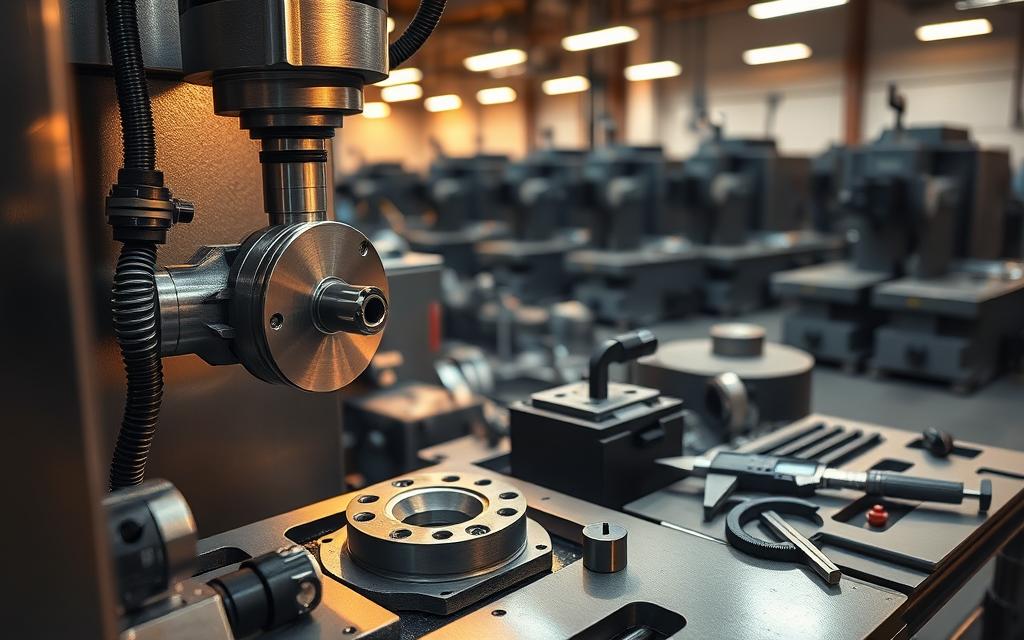
Machining is at the core of modern manufacturing. It shapes our world in a unique way. This subtractive manufacturing method is different from additive ones like 3D printing.
The main idea is to remove material from a bigger piece. This careful process makes parts with exact shapes, sizes, and smooth finishes.
This manufacturing process is key for many industries. It’s used for everything from aerospace parts to everyday items. Its uses are endless.
Precision engineering through machining makes parts that are very accurate and reliable. It’s a vital method for making top-quality parts worldwide.
Defining What Is Machining Technology
Machining technology is key to making things in factories. It lets us make complex parts by taking away extra material. This method turns raw materials into finished parts using special tools and equipment.
The Core Principle of Material Removal
The basic idea of machining is using a hard tool to cut away material. This makes chips or swarf as byproducts. It’s all about controlled cutting.
To cut metal well, you need a few things. First, the tool must be harder than the material. Second, the tool and material must move together precisely. Lastly, enough force must be applied. These steps help remove material accurately and keep the process stable.
Today, we use advanced tools like carbide, ceramic, or diamond. These tools stay sharp even when they’re under a lot of heat and pressure.
Related Posts:
- How Many Technology Companies Are in the World A…

- What Is Biorock Technology Mineral Accretion for…

- How Does Cloud Technology Work Storing and Accessing…

- What Are Off-Target Effects in CRISPR Technology…
- What Is Dri-FIT Technology Nike's Moisture-Wicking Fabric

- Is Technology in the Classroom Good or Bad Weighing…

Key Objectives in Machining Processes
Machinists aim for several important goals. These ensure the final product is just right and meets quality standards.
- Dimensional accuracy – Getting exact measurements from engineering drawings
- Tight tolerances – Keeping very small variations in size
- Superior surface finish – Making smooth, flawless surfaces
- Process repeatability – Getting the same results every time
In CNC machining, these goals are even more important. CNC systems use programs to make things the same every time. This means we can make lots of identical parts with great consistency.
Working towards these goals makes machining better. Companies keep finding new ways to make things more precise and efficient. They develop new tools and strategies to improve quality and speed up production.
Historical Development of Machining Techniques
The history of machining technology is truly captivating. It shows how people’s creativity turned simple tools into precise machines. These machines have greatly shaped our modern world.
From Manual Craft to Industrial Revolution
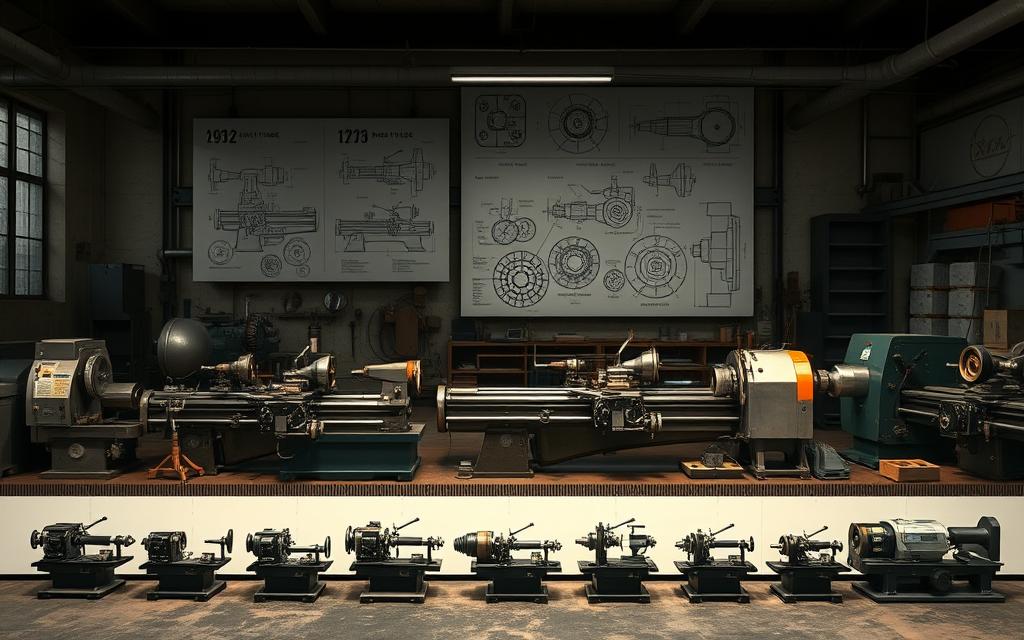
Before the 18th century, making things was all about manual skill. People used files, chisels, and hand-operated lathes. The quality of what they made depended on their skill.
The Industrial Revolution changed everything. James Watt’s steam engine needed precise parts, leading to new machine tools. Henry Maudslay created the first metal lathes around 1800, starting standardised manufacturing.
Important developments included:
- Screw-cutting lathes for standardised threading
- Planers and shapers for flat surfaces
- Interchangeable parts systems for better production
This change turned workshops into factories. The lathe’s history shows how manual work became mechanised. This helped drive industrialisation forward.
20th Century Advancements and CNC Introduction
After World War II, technology made huge strides. New methods joined old ones, changing what manufacturers could do.
Electrical Discharge Machining (EDM) started in the 1940s. It used electrical sparks to cut hard metals. This was a big step forward.
The biggest leap was Computer Numerical Control (CNC). Early NC systems used punched tape in the 1950s. But true CNC came with microprocessors in the 1970s. It made machines work with digital instructions.
CNC brought three big benefits:
- Unmatched precision and consistency
- Ability to make complex shapes
- Less human error and faster production
The move to computer control marked a big change. Today’s machining is a result of centuries of innovation in tools and methods.
Fundamental Machining Processes: Turning and Milling
Turning and milling are key methods in modern manufacturing. They are essential for making precise parts in many industries.
Turning Operations and Lathe Machinery
Turning is a vital lathe operation in making things. It involves moving a workpiece against a tool to cut away material from its outside.
Engine Lathes and Their Functions
Engine lathes are the main machines for manual machining. They can do many lathe operations like facing, tapering, and threading. People use handwheels and levers to control the tools, making them great for small projects.
CNC Turning Centres and Modern Applications
Computer Numerical Control (CNC) has changed turning technology a lot. Today’s centre lathe machines have tools that change automatically and can do complex tasks. This makes them perfect for making lots of parts.
“CNC turning centres have changed what’s possible in making parts that rotate. They can make parts with very small tolerances and keep them consistent.”
Milling Techniques and Mill Equipment
Milling uses tools that spin to cut away material from a workpiece that doesn’t move. It’s good for making flat surfaces, slots, and complex shapes.
Vertical and Horizontal Milling Machines
Milling machines are mainly vertical or horizontal. Vertical ones are best for making deep cuts. Horizontal ones are better for removing a lot of material and for doing many tasks at once.
CNC Milling Centres and Complex Geometries
Modern CNC mill technology lets makers create parts with very detailed features. These machines can move in many directions, change tools automatically, and manage coolant well.
The table below compares key characteristics of turning and milling processes:
| Process Type | Primary Motion | Typical Applications | Surface Finish Quality |
|---|---|---|---|
| Turning | Workpiece rotation | Shafts, bushings, fittings | 0.8-3.2 μm Ra |
| Milling | Tool rotation | Housings, molds, gears | 0.4-1.6 μm Ra |
| CNC Turning | Programmed rotation | Complex rotational parts | 0.4-0.8 μm Ra |
| CNC Milling | Multi-axis tool movement | 3D contours, pockets | 0.2-0.8 μm Ra |
Both milling processes and turning operations are getting better with new technology and software. Knowing these basics helps us understand more advanced manufacturing methods.
Drilling, Boring, and Grinding Methods
Machining technology includes many important processes. These help make precise holes and smooth surfaces. They are key to making high-quality parts with tight tolerances.
Drilling and Boring Processes
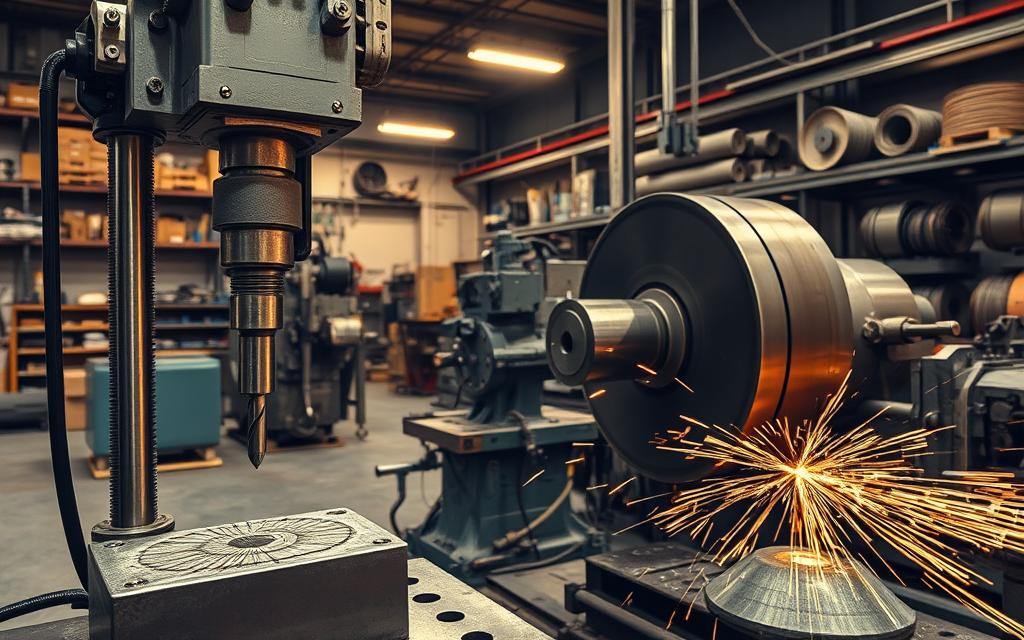
Drilling is a basic hole making method in making. It uses a rotating tool called a drill bit to make holes in solid materials. A drill press is used for this, as it provides stability and precision.
Standard Drilling Machines and Tools
Drilling equipment ranges from simple to advanced. The drill press has a base, column, table, and spindle for tools. Different drill bits are used for various materials:
- Twist drills for general-purpose holes
- Center drills for accurate positioning
- Step drills for holes of different diameters
- Indexable insert drills for large volumes
Precision Boring and Its Importance
Boring is used after drilling to get precise hole sizes. It enlarges and refines holes using single-point tools. This process makes holes perfectly round and smooth.
Boring is very important for parts needing tight tolerances. It helps make holes exactly as needed for parts like engine cylinders and bearings.
Grinding and Abrasive Techniques for Finishing
Grinding is a top method for precision machining. It uses abrasive particles to remove small amounts of material. This makes it better than cutting methods for surface finishes and accuracy.
Surface Grinding for Fine Finishes
Surface grinding makes flat surfaces on workpieces. A grinding wheel rotates and moves over the surface, removing material. This can make surfaces as smooth as 0.25 micrometres.
Modern grinders have automatic systems and digital displays. They help make consistent results. This method is great for making surfaces for sealing and precision measurements.
Cylindrical Grinding for Round Components
Cylindrical grinding works on round parts. The workpiece rotates while a grinding wheel presses against it. This makes the diameter and surface finish precise.
This method can get tolerances as tight as 0.0025 mm. It’s vital for parts in aerospace, automotive, and medical fields.
Electrical Discharge Machining (EDM) Principles
EDM is different from traditional cutting methods. It uses thermal energy, not mechanical force, to shape materials. This non-traditional machining process works by creating electrical discharges between an electrode and workpiece. It’s great for hard metals that are hard to cut with usual tools.
The basic idea is to put both the electrode and workpiece in dielectric fluid. Electrical sparks make very hot spots that vaporise tiny material bits. This spark erosion happens thousands of times a second. It makes precise cavities or profiles without touching the material.
Wire EDM and Complex Contouring
Wire EDM uses a thin, charged wire as the cutting tool. It’s great for making complex shapes and profiles. It’s also good for cutting through hard materials.
The wire is very thin, between 0.02-0.33 mm. This lets it make fine details and tight tolerances. Modern systems have automatic wire threading for smooth cutting. This makes Wire EDM perfect for making precise parts for aerospace and medicine.
Sinker EDM for Mold and Die Production
Sinker EDM, or ram EDM, makes complex three-dimensional cavities. It’s a game-changer for tool and die making. It makes detailed molds and dies with great accuracy. It also overcomes many problems with cutting hard tool steels.
Electrodes are made from graphite or copper and are very precise. The dielectric fluid keeps the workpiece cool and removes particles. This method lets makers create complex molds and dies that can’t be made by mechanical cutting.
The car and consumer goods industries use Sinker EDM a lot. It gives great surface finishes and keeps dimensions stable. For more on electrical discharge machining, check out special resources.
Materials Commonly Used in Machining
Choosing the right materials is key to successful machining. Each material has its own challenges and benefits. This means we need to use specific tools and settings to get the best results.
Metals: Aluminium, Steel, and Titanium
Metals are the most common materials machined across many industries. Each metal has its own special traits. These traits affect how we machine them and how well they perform.
Aluminium is known for being easy to machine and light. It’s soft, so we can cut it fast and use tools for a long time. Machining aluminium makes chips that are easy to manage with the right chip breakers.
Steel is strong and durable. Knowing about stainless steel properties is important for machining. Austenitic stainless steels harden when worked on, needing sharp tools and cool conditions. Martensitic grades need slower speeds but get very hard after heating.
Titanium is strong but hard to machine. Titanium machining needs special tools and strong machines because it doesn’t conduct heat well. Cool tools help prevent hardening and make tools last longer.
| Material Type | Machinability Rating | Typical Applications | Special Considerations |
|---|---|---|---|
| Aluminium Alloys | Excellent | Aerospace components, automotive parts | High cutting speeds, minimal tool wear |
| Stainless Steel | Moderate | Medical instruments, food processing equipment | Work hardening tendency, requires sharp tools |
| Titanium Alloys | Challenging | Aerospace structures, medical implants | Low thermal conductivity, specialised tooling needed |
| Copper & Brass | Good | Electrical components, plumbing fittings | Gummy material, requires positive rake angles |
Plastics and Composites Machining Considerations
Non-metallic materials need different machining methods than metals. Plastics and composites must be handled carefully to keep their shape and surface quality.
Thermoplastics like nylon and acetal get softer when heated during cutting. Keeping them cool helps avoid melting and ensures they stay accurate. Sharp tools with positive angles help make clean cuts without damage.
Thermoset plastics, such as phenolics and epoxies, are more brittle. They need tools with smooth flutes to avoid chip packing and get smooth finishes. These materials make powder-like chips instead of continuous swarf.
Composite materials are very challenging to machine. Carbon fibre reinforced polymers (CFRP) and other composite materials need special tools to prevent damage. Diamond-coated tools often work best for these materials.
Important things to consider for non-metallic machining include:
- Reduced cutting forces to prevent material distortion
- Specialised tool geometries for different material types
- Temperature control to avoid thermal damage
- Dust extraction systems for composite machining
Getting plastics and composites right means understanding how they react to cutting forces. By adapting our methods to each material, we can achieve high-quality results in many areas.
Computer Numerical Control (CNC) Technology
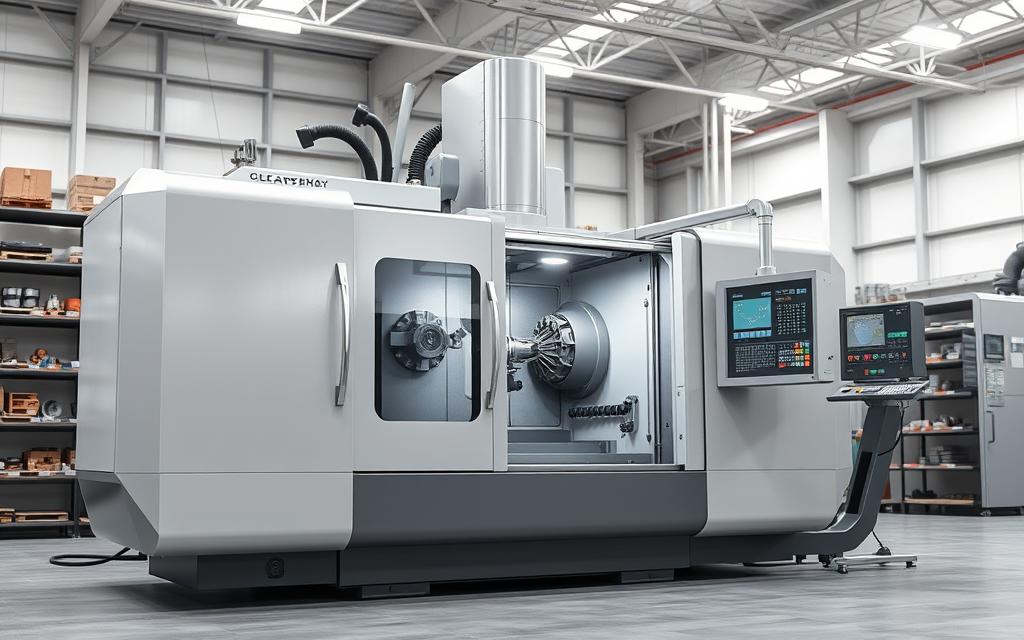
Modern manufacturing relies on computer numerical control (CNC) technology. It turns digital designs into real parts with precision. This is done through automated machines.
How CNC Systems Operate and Programmes Are Developed
CNC systems use motors, drives, and controllers to move. They work together to follow precise instructions.
Designers start with CAD models. They use computer-aided design software to create detailed digital parts.
CAM software then turns these models into instructions. These instructions, or G-code, guide the CNC equipment’s movements.
Skilled technicians make sure the code works with the material and tools. They check it’s right for the job.
Benefits of CNC Over Conventional Machining
CNC technology has big advantages over manual methods. It has changed how many industries work.
It makes parts the same every time. This is true even for big runs.
It can make complex shapes. This is because it controls the machines precisely.
It also cuts down on mistakes. Machines don’t make the errors humans do.
It makes making lots of parts faster. CNC machines can work for hours with little help.
| Aspect | Conventional Machining | CNC Machining |
|---|---|---|
| Precision Level | Dependent on operator skill | Consistent high precision |
| Production Speed | Slower for complex parts | Faster automated operation |
| Labour Requirements | Constant supervision needed | Minimal supervision required |
| Error Rate | Higher chance of mistakes | Less chance of errors |
This change in manufacturing is big. Companies using CNC get better quality and speed. This helps them compete better.
Using CAD/CAM systems is key for modern making. It makes going from design to product easy.
Applications Across Industries
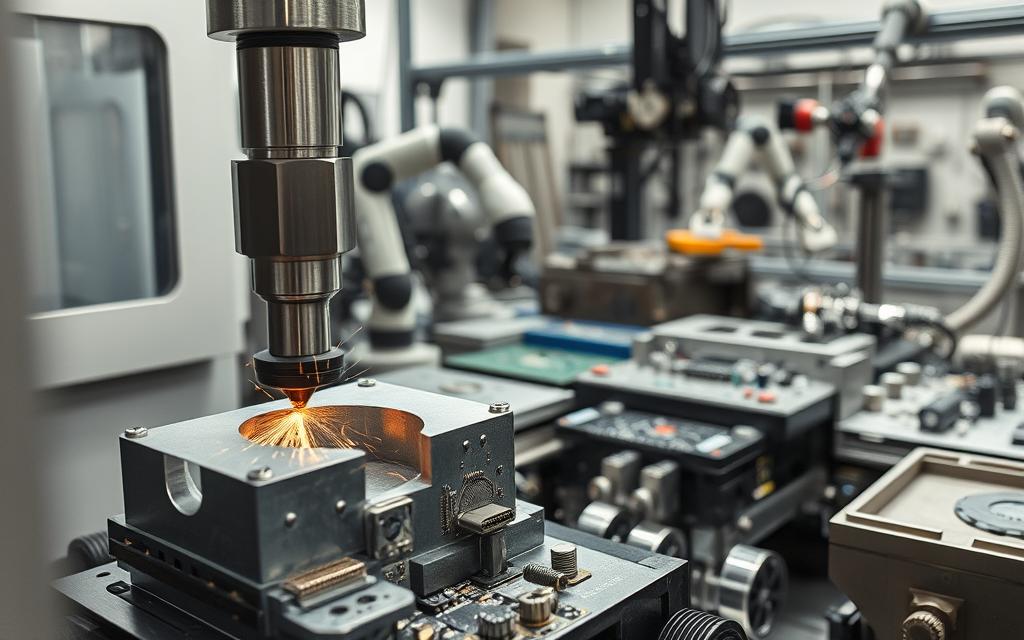
Machining technology is key to modern production. It turns raw materials into essential parts that drive our world. From everyday appliances to complex systems, it makes parts with high accuracy and reliability.
Aerospace and Defence Component Manufacturing
The aerospace and defence fields need top-notch quality and performance. Machining technology provides the precision needed for parts that face huge forces and harsh conditions.
Key applications in this sector include:
- Turbine blades with complex aerodynamic profiles
- Landing gear components requiring exceptional strength
- Structural elements with precise weight specifications
- Avionics housings with intricately designed cooling channels
These aerospace parts often use advanced materials like titanium and nickel alloys. The machining must keep dimensions accurate to microns and ensure surfaces meet strict standards.
“The reliability of aerospace systems depends fundamentally on the precision of machined components, where tolerances are measured in thousandths of millimetres.”
Automotive Engine and Transmission Production
Automotive manufacturing heavily relies on machining technology. It produces the engine and transmission systems, the heart of every vehicle. These parts need mass production without losing precision or durability.
Modern automotive plants use advanced machining centres to make:
- Engine blocks with precisely bored cylinders
- Cylinder heads with complex valve arrangements
- Transmission gears with perfect tooth profiles
- Drive shafts requiring balanced rotational dynamics
The move to electric vehicles has brought new machining challenges. Battery housings, motor parts, and power electronics all need precision engineering for top performance and efficiency.
Industrial manufacturing facilities keep innovating their machining to meet new automotive standards. They set up smarter production lines that can quickly adjust to design changes while keeping quality consistent across thousands of parts.
Advantages and Limitations of Machining Technology
Machining technology is a mix of amazing benefits and some challenges. It’s key to know both sides to choose the right way to make things.
Precision and Repeatability Strengths
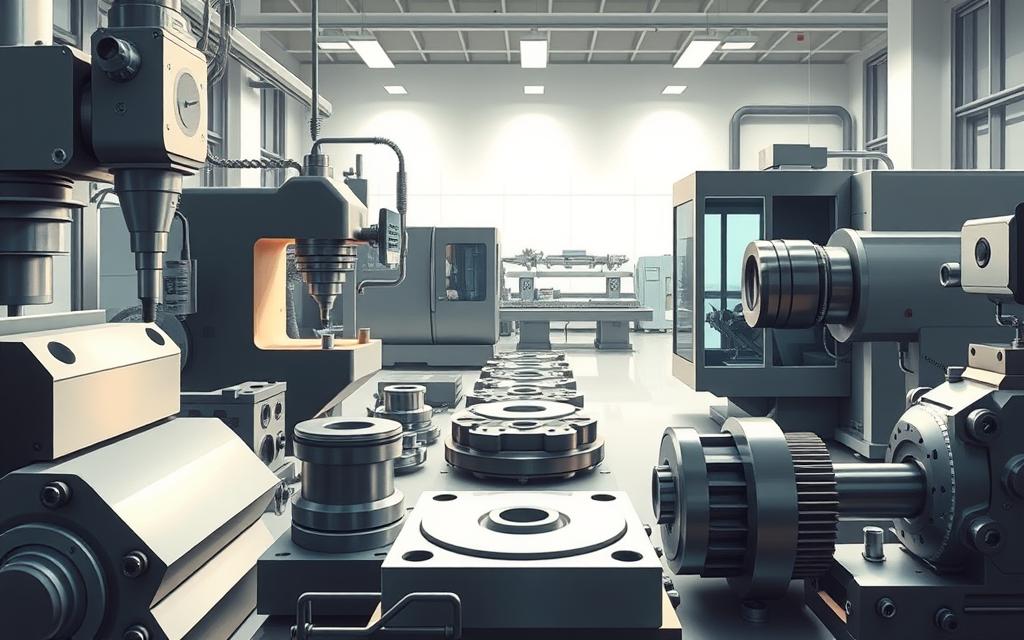
The biggest advantages of machining are its unmatched precision and consistency. Modern CNC systems can hit tolerances in microns, making parts very accurate.
This tech also creates top-notch surface finishes, often needing no extra work. It can make thousands of parts that are almost identical, with very little difference.
This reliability is vital for industries where parts must fit perfectly. In fields like aerospace and medical devices, machining ensures parts work flawlessly every time.
Material Waste and Energy Consumption Challenges
But machining also has its downsides, like its effect on the environment. It’s a subtractive process, which means material is cut away to make the final product. This leads to a lot of waste.
This is a big limitation of subtractive manufacturing. The waste, like chips and scrap, is a lost resource. It affects costs and material utilisation rates.
Another issue is energy use. Machine tools need a lot of power, which is bad for the environment. This adds to the carbon footprint of making things.
The industry is trying to make machining greener. They’re using new ways to make it more sustainable machining. For example:
- Recycling metal chips and cutting fluids
- Optimising tool paths to cut less material
- Using energy-saving machines and methods
- Creating near-net-shape preforms to cut down waste
These steps show the industry’s effort to reduce harm to the environment. They want to keep the precision benefits of machining while being kinder to the planet.
Future Trends in Machining Technology
The world of manufacturing is changing fast, thanks to new technologies. These changes are making it easier to create precise parts. Two big areas to watch are the mix of additive and subtractive processes and the use of artificial intelligence.
Additive and Subtractive Hybrid Manufacturing
Hybrid manufacturing is a big step forward in making things. It combines 3D printing’s ability to create complex shapes with CNC machining’s precision. This means you get the best of both worlds in one system.
The benefits are clear:
- It’s easier to make parts with complex shapes because of additive methods
- Subtractive machining makes sure the surfaces are smooth
- It uses less material than traditional methods
- Parts are made faster, even if they’re complex
This mix of additive and subtractive methods lets makers create parts that were hard or expensive before. It’s great for parts with special needs, like internal channels or complex cooling systems.
Artificial Intelligence and Machine Learning Integration
AI in machining is another big change in Industry 4.0. Now, smart systems use advanced algorithms to make production better in real-time.
Here’s what it can do:
- It predicts when machines might break down
- It adjusts settings based on what it sees
- It checks quality automatically
- It plans production based on past data
These smart systems gather lots of data. Machine learning finds patterns that humans might miss. This leads to better efficiency, less downtime, and higher quality.
As these technologies get better, we’re moving towards factories that can run without much human help. This is a big change, not just a small improvement.
The mix of hybrid manufacturing and AI is creating something new and exciting. It’s making it easier to meet complex design needs while being more efficient and sustainable. This is key for the future of manufacturing.
Conclusion
Machining technology is key in today’s production. It allows for precise shaping of materials, from metals to composites. This shows how it has grown from manual work to computer-controlled systems.
Its role in achieving high accuracy and repeatability is clear. This is seen in sectors like aerospace and automotive. Here, components need exact tolerances.
Processes like turning, milling, and EDM make this possible. They are driven by advancements in CNC programming.
As industries change, machining keeps up with new innovations. Hybrid manufacturing and AI integration are examples. They reduce waste and make production more efficient.
This summary shows machining’s lasting importance. It confirms its role in future industrial progress.
FAQ
What is the core principle behind machining technology?
Machining technology removes material from a workpiece using a harder tool. This process involves moving the tool and workpiece together. It creates chips to get precise shapes and finishes.
How does Computer Numerical Control (CNC) improve machining processes?
CNC uses computer programmes to automate machining. These programmes come from CAD models and are converted into G-code. This makes machining more precise, efficient, and consistent.
What are the key differences between turning and milling operations?
Turning is done on lathes and makes cylindrical parts. Milling, on the other hand, uses rotating tools to remove material from a stationary workpiece. It creates flat surfaces and complex shapes.
Which materials are commonly machined, and what are their specific challenges?
Aluminium is lightweight and easy to machine. Steels are strong and versatile. Titanium is hard to machine but strong. Plastics and composites need careful handling to avoid damage during cutting.
What is Electrical Discharge Machining (EDM), and when is it used?
EDM uses electrical sparks to erode material. It’s great for hard or complex shapes. Wire EDM cuts complex profiles, while sinker EDM makes moulds and dies.
How does grinding differ from other machining processes?
Grinding uses a rotating wheel to remove material. It achieves excellent surface finishes and tight tolerances. It’s often used for finishing operations.
What are the main advantages and limitations of machining technology?
Machining offers high precision and surface finishes. But, it wastes material and uses a lot of energy. Efforts are being made to improve sustainability.
What role does machining play in the aerospace and automotive industries?
In aerospace, machining makes critical components like turbine blades. In automotive, it produces engine blocks and gears. These parts ensure vehicle performance and durability.
What future trends are shaping the evolution of machining technology?
Trends include hybrid manufacturing and the use of AI and machine learning. These advancements aim to improve efficiency and enable autonomous manufacturing.
